Children of the Alley Re-Covering Design

¶ 1 Leave a comment on paragraph 1 2 The novel I chose has many complexities embedded in the plot, and in order to analyze it, the reader has to have an adequate amount of historical backgrounds for religions. However, since I assume most of the class haven’t read the novel, I will try to summarize the plot. In brief, the novel talks about Geblawi, who is the sole male head of a family, and his five children. They all live in a huge mansion which later becomes the center of conflict between Geblawi’s descendants, who all want to take over it. The children and their big families move to the alley close to the mansion (some were exiled by Geblawi) and go through different life experiences, some of them become powerful and turns into greedy tyrants, while others become miserable and poor.
¶ 2 Leave a comment on paragraph 2 0 The previous covers of the novel all had a type of painting, whether it’s a painting of an alley with old buildings, or a painting of an Egyptian man wearing traditional clothes, the painting was always present. Also, Mahfouz’s name was displayed in capital letters, while the title of the novel was in small ones (except in the first issue.) Besides, the emphasis on him being a Noble prize winner was present in the two English translations of the book.
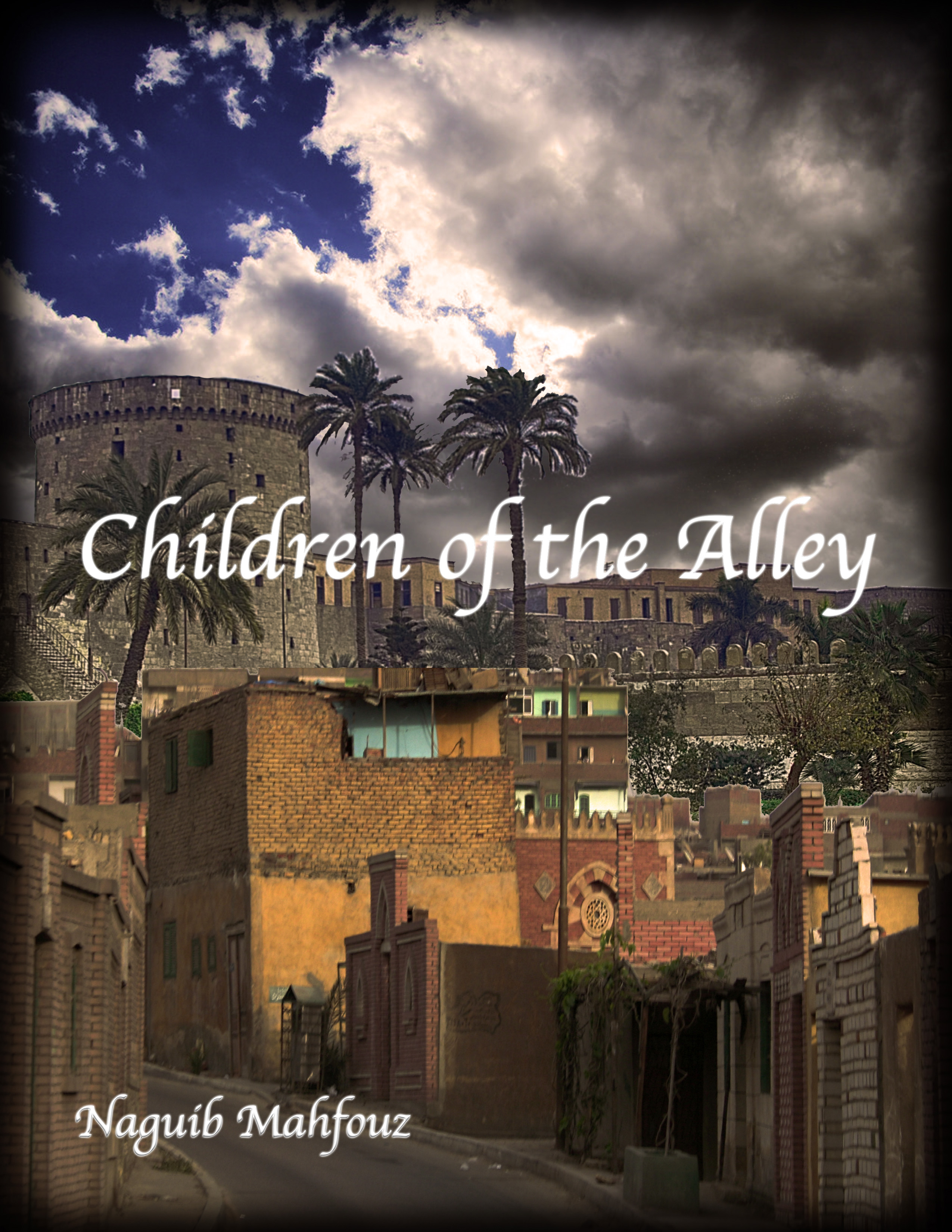
¶ 3 Leave a comment on paragraph 3 3 However, in my design, I tried to shift the attention from paintings to photography in order to give the novel a modern twist since it was written in the 1950s. I was looking for a picture of a clay built castle with palm trees around it because I felt that it would convey how old and secluded Geblawi is, but at the same time duplicate the old castles that were built in Egypt. I have used three almost HD photos of an old mansion an Egyptian alley, and gloomy looking clouds. I think it’s obvious why I chose the first two photos, one to represent Geblawi’s mansion and the other to represent the alley close to it. The reason I put the mansion above the alley is to replicate Geblawi’s status in the family as being the father of everybody who happen to be living underneath him. The picture of the alley implicates that habitants of the alley are from a low class (poor.), but there is a road that leads to the mansion and also to the rest of the alley where others might be living in better conditions!. The third image which is the gloomy clouds represents the ups and downs that people go through, and also the uncertainty of the future for Geblawi and his offspring. I tried to balance the colors of all three photos and give them a wormer touch in an indication to the struggle all the characters go to. Finally, I highlighted the cover with black to give it a feel as it was a physical book.
¶ 4 Leave a comment on paragraph 4 2 The font I used is Apple Chancery. Why I used it? because from my humble artistic point of view looked appropriate to the whole theme and kept the handwritten effect the other editions had. I chose white for the font to distinguish it form the other dark and earthy colors of the pictures. Also, unlike the earlier covers, I reduced the font size for the writer’s name, while enlarged the title because I believe a great novel is always read for its contents, not because of how famous the writer is. I think my re-covering gives the novel a fresh and modern look a way from the outdated covers it used to have, besides it switches the attention from the author to the actual novel.


I haven’t read the book, but I very much like the cover that you designed based on your explanation of the plot. However, if certain religious histories are central to the text, I wonder if the cover shouldn’t at least give a nod to this aspect of the story? I’m not sure how central the religious piece is, but it might be something to consider.
It’s always possible to link the religious histories to the cover; however, I don’t think that it would do the book any good, given the fact this book faced severe criticisms and rejection from a large audience who believed that it disrespected religious aspects and figures.