EWL.org / Metadata Assignment: Revision Roundup

¶ 1 Leave a comment on paragraph 1 0 Thanks, first, for all of the hard work that you put into the EWL.org / Metadata assignment. I’m very pleased to report that, thanks to your collective efforst, the EdithWhartonsLibrary.org database now contains 516 searchable entries, which is another way of saying that we have nearly 1/5 of it done.
¶ 2 Leave a comment on paragraph 2 0 I learned a lot from overseeing this assignment, and from assessing your uploads and contributions to the site. For example, I came away with the knowledge that I need to front-load the assignment itself with a discussion of bibliographic style and traditional methods of bibliography. That, I think, would result in less confusion with regards to the Ramsden catalog, and fewer errors where bibliographic specifics — like book size (12mo, 8vo, quarto, etc.) — are concerned. So thanks for bearing with me, in the meantime, and for teaching me, in turn.
¶ 3 Leave a comment on paragraph 3 0 Rather than providing feedback on a case-by-case basis for this assignment, I thought I’d outline some common, general errors that I noticed when reviewing everyone’s entries. They include:
¶ 4 Leave a comment on paragraph 4 0 TAGS: This is something we ought to discuss more and class, and something that digital humanists are fond of analyzing (often to extremes). How many tags are constitute “enough” tags? How specific should we get when providing tags that relate to subject matter or content? And what about non-content-related tags (condition of the physical book, associations / previous owners, etc.)? Many of you lost points for failing to include any tags at all on a given item, which might have been the result of your having forgotten to “add” the individual tags into the database, or the result of your having overlooked that step altogether. But I also noticed wide degrees of disparity with regards to tagging and, in the future, hope to spend more time discussing the function and purpose of tagging in order to streamline that part of the process a bit.
¶ 5 Leave a comment on paragraph 5 1 SPELLING / GRAMMATICAL ERRORS: This is an important area of consideration, though it’s one that’s often overlooked in our current age of Spell Check and squiggly red lines. In building this database, what I’m essentially doing is trying to create a searchable record; searchability, though, requires consistency and attention to detail. If a user types in the name “Wilkie Collins” (British author of The Moonstone and other novels; Wharton has a few Collins novels in her library) but the entry for the file spells the author’s name “Willy Collins” (yes, this happened …), then the user’s query will return 0 results and they will walk away from the experience assuming that Wharton did not read or did not possess any of Collins’ books. So, what all this means is this: spelling matters. So does grammar. Several of you lost points for spelling proper nouns (author’s names, titles of books, etc.) incorrectly, or for using casual syntax or incorrect grammar in your descriptions of individual items. This result, I think, might have been prevented in part if we had had time to conduct the “peer review” portion of the assignment, like I had planned; in the future, I’m going to try to budget more time so that we can make sure that the peer review takes place.
¶ 6
Leave a comment on paragraph 6 0
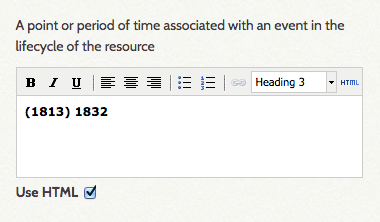 HTML vs. DEFAULT TEXT SETTINGS: You were directed to convert the text of a given field to html only for one entry: The “Title” (Subject). I instructed you to do so because formatting the text in html gave you options to play with the font size, etc., and I wanted Title / Subject entries to stand out from the rest of the text that appears in connection with an individual entry. Some of you, however, retained the “html” setting for all of the required fields, forcing me to go back through and convert these fields / entries back to the default Omeka text setting (to avoid having all of the text display in size 14 font and get squished together); meanwhile, some of you forgot to check “Use HTML” with regards to the Title / Subject field, which forced me to go back and re-enter the text for those fields using html (see example, left).
¶ 7
Leave a comment on paragraph 7 0
PUBLIC INFORMATION vs. PRIVATE COMMENTS: I mentioned in class that, to a certain extent, this assignment would be helpful in allowing me to see errors, notice bad scans, and record information related to missing scans / files. I instructed you to let me know when you came across a bad, incomplete, or missing scan, and many of you did this. Some of you, however, did this by providing comments to me on the public record (read: published item) itself, which was definitely not what I intended. The last thing I want is for public users experimenting with the beta site to come across notes about a “bad” or “unreadable” scan, or a missing file, etc. So, where I noticed this information had been recorded along with the item description, I had to erase or remove it.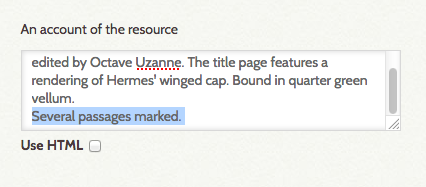
¶ 8 Leave a comment on paragraph 8 0 INSUFFICIENT DESCRIPTORS / INFORMATION ABOUT AN ITEM: In certain cases, I came across an item that had been uploaded to the catalog with either no descriptors / a blank “Description” field, or with insufficient /incorrect information included in that field. For instance, many of you were assigned to items that contained markings, and it’s very important that we note any and all markings to the text in the catalog itself, since that is what scholars and users are likely to be more interested in. However, some of you failed to mention the markings or annotations, or else failed to comb through the scan and take note of them in the first place (see example, right). The result was that I had to go back in and edit the entry to make sure that it alerts users to the existence of annotations and markings.
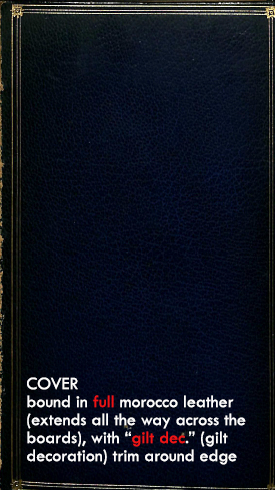
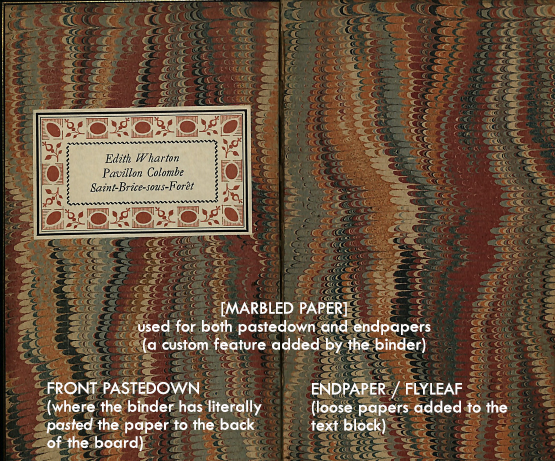
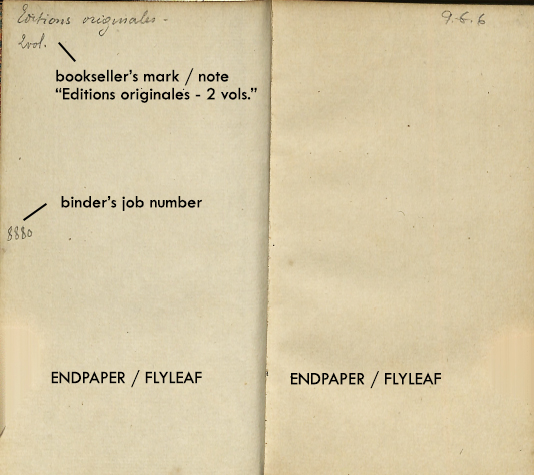
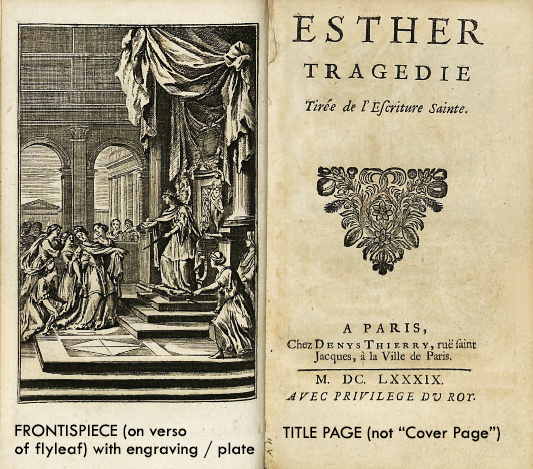
¶ 9 Leave a comment on paragraph 9 1 CONFUSION ABOUT BIBLIOGRAPHIC TERMS: Again, this is on me: you weren’t expected, prior to this assignment, to know what terms like “8vo” or “dec. gilt” mean. But what’s interesting to me is that, as an instructor, the confusion I noticed regarding bibliographic terminologies and conventions — and the work that I had to put into correcting for these confusions — has revealed, to me, the close link between bibliography (arguably the “oldest” or most traditional of humanistic research methods) and DH methods. It is as Jerome McGann says, and understanding books as historical, physical objects is absolutely related to our abilities to digitize and display their contents for wider audiences. In this particular case, I had to spend a lot of time correcting descriptions of binding or other physical attributes because, as I now understand, these details are not part of one’s “average” training in humanities or literary study these days. Which has made me see the need for courses in printmaking and book history in our English curriculum here at UND.
¶ 10 Leave a comment on paragraph 10 0 As such, in the future, I might aim to spend more time reviewing standards for bibliographical notation, and surveying the parts and components of a book in order to avoid all this confusion. Labeled images, for example, might have helped: for instance, what do you think of these?
¶ 11 Leave a comment on paragraph 11 0
¶ 12
Leave a comment on paragraph 12 1
¶ 13 Leave a comment on paragraph 13 0 Thanks again, everyone, for your work on this assignment. Overall, I’m very pleased with the result and I know that I, for one, have learned a lot.


This part really made me think, did I double check my work enough? I know myself to be someone to frequently overlook simple mistakes in grammar and spelling. I also thought, who’s job is it to double check in a DH project like this? Pretty clearly, it’s on you, or us, if we’re the one entering the info. If you entered every single text on your own, it would be up to you to double check. There’s no editor in a project like this, right? There’s not peer review process. Sure, there might be scholars down the road who find an error and notify The Mount’s webmaster, but that’s not really the same as editing something before publication. Sure, self editing is a personal responsibility, but in a lot of cases, we have a back up. I just thought that was a unique problem to have.